


Page 322 - Национальная школа
P. 322
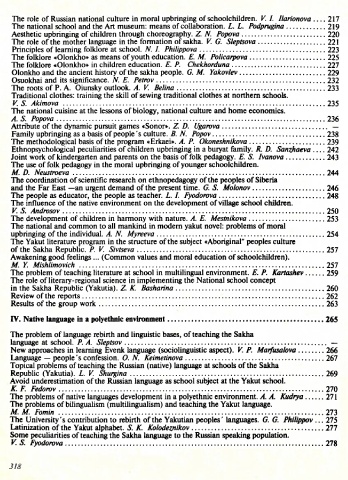
The role of Russian national culture in moral upbringing of schoolchildren. V. I. Ilarionova .... 217
    The national school and the Art museum: means of collaboration. L. L. Podprugina.....................219
    Aesthetic upbringing of children through choreography. Z. N. Popova............................................ 220
    The role of the mother language in the formation of sakha. V G. Sleptsova....................................221
    Principles of learning folklore at school. N. I. Philippova.................................................................. 223
    The folklore «Olonkho» as means of youth education. E. M. Policarpova........................................225
    The folklore «Olonkho» in children education. E. P. Chekhorduna................................................. 227
    Olonkho and the ancient history of the sakha people. G. M. Yakovlev............................................. 229
    Osuokhai and its significance. N. E. Petrov........................................................................................ 232
    The roots of P. A. Oiunsky outlook. A. V. Belina..............................................................................233
    Traditional clothes: training the skill of sewing traditional clothes at northern schools.
    V. S. Akimova .........................................................................................................................................235
    The national cuisine at the lessons of biology, national culture and home economics.
    A. S. Popova............................................................................................................................................ 236
    Attribute of the dynamic pursuit games «Sonor». Z. D. Ugarova......................................................  —
    Family upbringing as a basis of people's culture. B. N. Popov........................................................... 238
    The methodological basis of the program «Erkaei». A. P. Okoneshnikova........................................239
    Ethnopsychological peculiarities of children upbringing in a buryat family. R. D. Sanzhaeva .... 242
   Joint work of kindergarten and parents on the basis of folk pedagogy. E. S. Ivanova.....................243
    The use of folk pedagogy in the moral upbringing of younger schoolchildren.
    M. D. Neustroeva....................................................................................................................................244
   The coordination of scientific research on ethnopedagogy of the peoples of Siberia
    and the Far East —an urgent demand of the present time. G. S. Molonov...................................... 246
   The people as educator, the people as teacher. L. I. Fyodorova........................................................248
   The influence of the native environment on the development of village school children.
    V. S. Androsov.........................................................................................................................................250
   The development of children in harmony with nature. A. E. Mestnikova........................................253
   The national and common to all mankind in modem yakut novel: problems of moral
   upbringing of the individual. A. N. Myreeva........................................................................................254
   The Yakut literature program in the structure of the subject «Aboriginal" peoples culture
   of the Sakha Republic. P. V. Sivtseva..................................................................................................257
   Awakening good feelings ... (Common values and moral education of schoolchildren).
   M. Y. Mishlimovich ................................................................................................................................257
   The problem of teaching literature at school in multilingual environment. E. P. Kartashev.........259
   The role of literary-regional science in implementing the National school concept
   in the Sakha Republic (Yakutia). Z. K. Basharina..............................................................................260
   Review of the reports............................................................................................................................. 262
   Results of the group work.....................................................................................................................263
   IV. Native language in a polyethnic environment..................................................................................265
   The problem of language rebirth and linguistic bases, of teaching the Sakha
   language at school. P. A. Sleptsov........................................................................................................  —
   New approaches in learning Evenk language (sociolinguistic aspect). V. P. Marfusalova............ 266
   Language — people's confession. O. N. Keimetinova.........................................................................267
   Topical problems of teaching the Russian (native) language at schools of the Sakha
   Republic (Yakutia). L. V. Shurgina..................................................................................................... 269
   Avoid underestimation of the Russian language as school subject at the Yakut school.
   K. F. Fedorov.......................................................................................................................................... 270
   The problems of native languages development in a polyethnic environment. A. A. Kudrya.........271
   The problems of bilingualism (multilingualism) and teaching the Yakut language.
   M. M. Fomin ................................................................................  273
   The University's contribution to rebirth of the Yakutian peoples' languages. G. G. Philippov ... 275
   Latinization of the Yakut alphabet. 5. K. Kolodeznikov..................................................................... 277
   Some peculiarities of teaching the Sakha language to the Russian speaking population.
    V.  S. Fyodorova......................................................................................................................................278


   318

